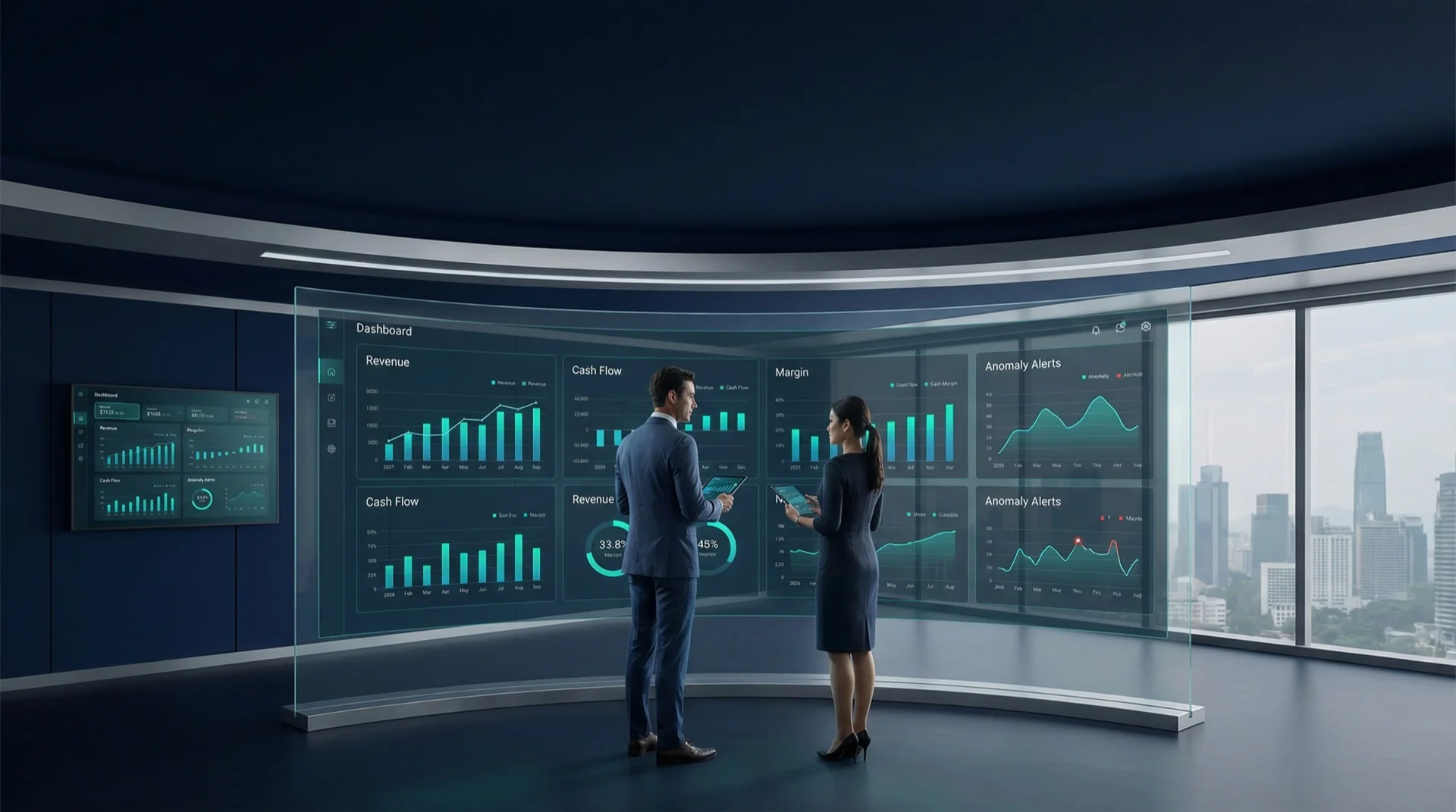
What is Middleware: Your Key to Business Decision Intelligence
Key Takeaways
- Middleware acts as a bridge between systems, enabling smooth data exchange and integration across applications, databases, and platforms.
- Decision Intelligence relies on middleware to provide real-time, reliable, and unified data for better, faster decisions.
- Types of middleware include message-oriented, object-oriented, transaction processing, and web middleware—each serving unique integration needs.
- Middleware supports key business functions like automation, AI analytics, real-time reporting, and ESG performance tracking.
Introduction
Every business decision—whether strategic or operational—relies on data. But raw data alone isn’t enough. To extract meaningful insights, systems need to communicate, applications must be integrated, and information must flow seamlessly across platforms.
That’s where Decision Intelligence (DI) comes in, combining data, technology, and human context to drive smarter actions.
But Decision Intelligence can only be as effective as the systems supporting it. When applications are siloed or disconnected, critical insights are delayed or lost.
Middleware solves this by acting as the connective layer between systems—quietly coordinating data, workflows, and services across an organisation.
This article explores what middleware is, how it empowers Decision Intelligence, and why it’s a key enabler of fast, informed business decisions.
What is Middleware?
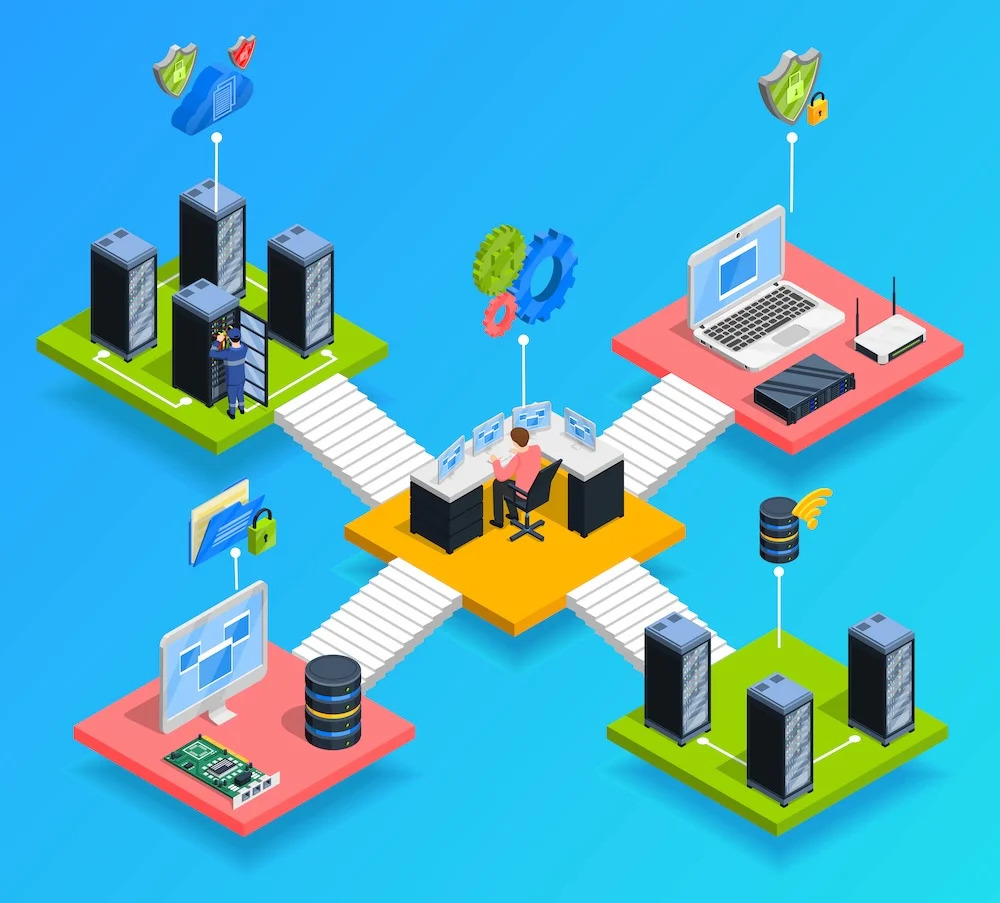
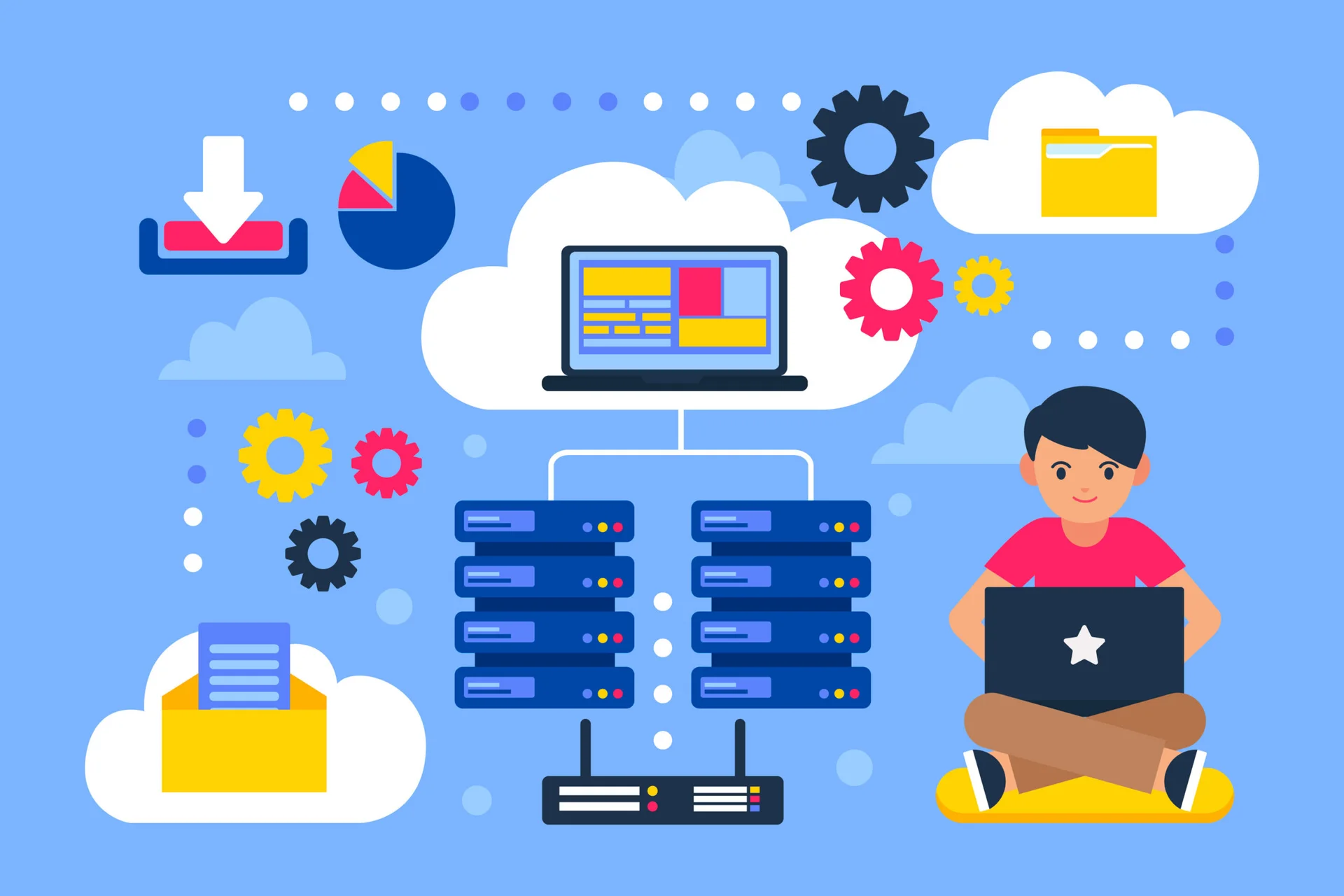
Middleware is software that sits between applications, databases, and users—helping different systems communicate and share data efficiently. It acts as a translator, allowing technologies that weren’t built to work together to exchange information smoothly.
From mobile apps and CRMs to cloud platforms and IoT devices, modern business systems rely on middleware to stay connected and operational. It serves as the bridge between front-end interfaces (what users see) and back-end systems (where data is stored and processed).
There are several common types of middleware used in enterprise environments, including:
- API Gateways: Manage and route communication between software applications.
- Message Queues: Facilitate data exchange between services asynchronously.
- Enterprise Service Buses (ESBs): Orchestrate complex integrations across large systems.
- Database Middleware: Enable access and interaction between databases and applications.
Think of middleware as a multilingual interpreter in a busy international airport—ensuring travellers, staff, and systems can all understand each other and move efficiently, despite speaking different languages.
Why Middleware matters in Decision Intelligence?
Effective Decision Intelligence depends on timely, accurate, and connected data. Without seamless communication between systems, even the most advanced analytics tools struggle to deliver meaningful insights. This is where middleware becomes essential.
Middleware helps unify data from otherwise disconnected platforms—creating a single source of truth that feeds decision models and analytics engines. Whether data comes from sales tools, finance systems, or IoT devices, middleware ensures it’s available, relevant, and ready for real-time use.
Decision Intelligence systems rely on middleware for:
- Timely data delivery: Ensures information flows between systems instantly to support fast, in-the-moment decisions.
- Secure and scalable integrations: Handles growing data demands and protects sensitive information across all endpoints.
- Context-aware decision flows: Enables smooth interaction between multiple applications to power intelligent, automated workflows.
By bridging silos and accelerating access to data, middleware makes it possible for businesses to act—not just analyse.
Types of Middleware
Middleware comes in different forms, each designed to support specific kinds of system interactions. Below are some of the most commonly used types:
Message-Oriented Middleware (MOM)
Facilitates asynchronous communication between applications by sending messages through queues. Ideal for distributed systems where components operate independently, MOM ensures data is delivered reliably—even if one system is temporarily offline.
Object-Oriented Middleware (OOM)
Enables communication between objects in different applications, often in object-oriented programming environments. It supports remote method invocation, making it easier for distributed objects to function as part of a unified system.
Transaction Processing Middleware (TPM)
Manages and coordinates transactions across multiple systems or databases. It ensures that all parts of a transaction are completed successfully—or rolled back entirely—to maintain data integrity.
Web Middleware
Connects web servers to back-end databases, APIs, or application servers. It handles user sessions, authentication, and content delivery, enabling dynamic and interactive web applications to function smoothly.
Applications of Middleware
Middleware plays a critical role in modern IT infrastructure, serving as the glue that holds complex systems together. Its applications span across industries and departments, enabling everything from operational efficiency to strategic insight.
- Enterprise system integration: Connects disparate platforms such as CRM, ERP, HRM, and finance systems—enabling unified workflows and centralised reporting.
- Cloud migration & hybrid environments: Bridges legacy on-premise systems with cloud applications, allowing businesses to transition gradually without disrupting operations.
- Real-time data exchange: Supports instant communication between systems like IoT devices, analytics dashboards, and mobile apps for up-to-the-minute decision-making.
- Web services & mobile applications: Powers interactive websites and apps by connecting them to backend services for functions like payments, search, and user authentication.
- Business process automation: Facilitates automated workflows by coordinating tasks across systems, reducing manual intervention, and improving speed.
In short, middleware is not limited to IT—it plays a foundational role in enabling data-driven decisions across marketing, operations, finance, and more.
How Middleware powers ‘Business Decision Intelligence’?
To make decisions faster, smarter, and at scale, businesses need connected systems that deliver context-rich data at the right moment. Middleware enables this by acting as the communication backbone across all platforms.
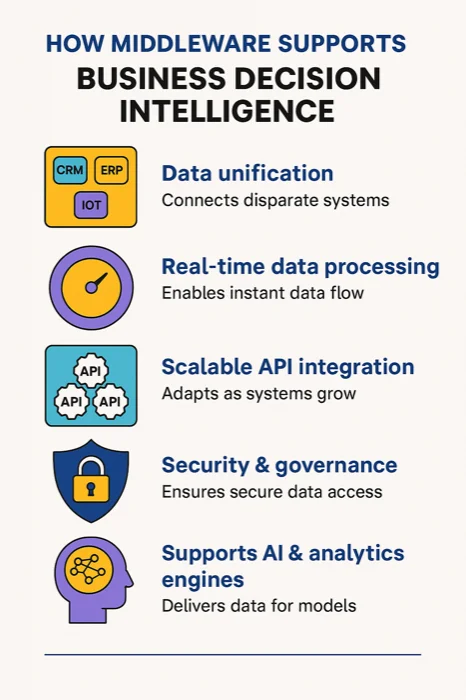
Here’s how it supports Business Decision Intelligence:
- Data unification: Connects systems like CRM, ERP, BI, and IoT—creating a single source of truth for accurate, centralised decision-making.
- Real-time data processing: Enables instant data flow between systems so that decisions can be based on current, not outdated, information.
- Scalable API integration: Supports seamless connectivity with internal tools and third-party platforms, adapting easily as systems evolve.
- Security & governance: Manages data access, authentication, and encryption to ensure secure and compliant data sharing between systems.
- Supports AI & analytics engines: Ensures decision models and analytics tools have clean, complete, and real-time data to drive predictive and prescriptive outcomes.
Business use cases: Middleware + Decision Intelligence
Middleware plays a critical role in enabling real-time, data-driven decisions across various sectors. Below are examples of how it supports Decision Intelligence in action:
- Retail: Integrates point-of-sale (POS) systems, customer relationship management (CRM), and analytics tools to enable real-time pricing, personalised offers, and inventory optimisation.
- Healthcare: Connects electronic health records (EHR), diagnostics platforms, and AI-powered analytics to support faster patient assessments and treatment planning.
- Logistics: Unifies data from GPS tracking, warehouse systems, and weather forecasts to dynamically optimise delivery routes and supply chain operations.
- Finance: Links fraud detection systems, transaction monitoring, and credit scoring models to automate risk alerts and improve lending decisions.
- ESG: Consolidates environmental, social, and governance data from HR, operations, and compliance systems to generate real-time dashboards for ESG performance tracking and reporting.
Middleware vs. Traditional System Integration
Traditional system integration often relies on point-to-point connections—custom-coded links between two specific applications. While this may work for small setups, it quickly becomes fragile, time-consuming to maintain, and costly as more systems are added.
Middleware, on the other hand, offers a more flexible and scalable solution. Instead of building direct links between each system, middleware serves as a central layer that manages communication and data exchange across the entire infrastructure. This reduces complexity, improves reliability, and allows for faster deployment of new tools or platforms.
Moreover, middleware supports real-time data exchange, standardised protocols, and built-in security features—capabilities that are either limited or absent in traditional integrations. It’s designed for dynamic environments where agility, data consistency, and smart decision-making are essential.
By enabling modular, loosely coupled architectures, middleware empowers businesses to innovate and scale without being held back by rigid system dependencies.
Common Middleware examples & tools
Middleware solutions come in many forms—ranging from open-source tools to enterprise-grade platforms—each tailored to specific integration and data flow needs. Here are some widely adopted options:
- Apache Kafka: A powerful event streaming platform ideal for real-time data pipelines, messaging, and log aggregation.
- MuleSoft: A popular integration platform that enables API-led connectivity between cloud and on-premise applications.
- Microsoft Azure Logic Apps: A low-code middleware solution that automates workflows and integrates with a wide range of Microsoft and third-party services.
- Oracle Fusion Middleware: A comprehensive suite that supports business process automation, application integration, and secure identity management.
- IBM WebSphere: Enterprise middleware for building and deploying scalable applications and services across hybrid environments.
Mandrill also builds custom middleware solutions to connect APIs, databases, analytics engines, and ESG platforms—enabling real-time data flow and seamless Decision Intelligence implementation across business systems.
How to choose the right Middleware for Decision Intelligence?
Choosing the right middleware solution is crucial for enabling effective Decision Intelligence.
Here are key factors to consider when evaluating options:
- Define integration goals and key decision points: Identify what decisions you want to enhance and which systems need to be connected to support them.
- Ensure compatibility with existing systems: The middleware should work seamlessly with your current tech stack—whether cloud-based, on-premise, or hybrid.
- Look for scalability and real-time data capabilities: Opt for solutions that can handle increasing data volumes and support real-time processing for faster decisions.
- Prioritise security, governance, and compliance: Make sure the middleware includes robust security protocols, access controls, and compliance support (e.g., PDPA, GDPR).
- Consider flexibility for future AI/analytics upgrades: The platform should support evolving business needs, including integration with AI models, analytics tools, and emerging technologies.
How Mandrill uses Middleware to support Decision Intelligence?
Mandrill provides tailored middleware solutions that support scalable, intelligent decision-making across complex business environments.
By focusing on seamless data integration and automation, these middleware systems serve as a foundational layer for delivering Decision Intelligence.
- Data integration & API automation: Connect siloed systems through APIs—enabling real-time data exchange between applications, databases, and analytics platforms.
- Connecting to AI & analytics platforms: Ensures that business intelligence systems and machine learning models receive consistent, clean, and timely data—boosting the accuracy of recommendations and forecasts.
- Real-time ESG tracking with Lestar: Aggregates sustainability data from various sources to power live dashboards and scenario simulations.
- Business Intelligence solutions: Offer integrated data platforms and customisable dashboards that transform complex datasets into actionable insights, enhancing operational efficiency and strategic planning.
- End-to-end workflow automation: By streamlining decision processes across departments—finance, operations, HR, compliance—middleware enables more agile, data-driven responses at every level of the organisation.
Conclusion
Middleware may work behind the scenes, but its role in powering smart, connected decision-making is front and centre. As businesses scale and adopt Decision Intelligence, the ability to integrate data from multiple systems in real-time becomes non-negotiable.
By enabling seamless communication between applications, ensuring data quality, and supporting AI-driven analytics, middleware lays the foundation for agile, insight-driven operations. It turns disconnected data points into actionable intelligence—fueling faster, smarter, and more strategic decisions.
For organisations ready to move from dashboards to dynamic decision-making, investing in robust middleware solutions is a critical step toward becoming truly data-intelligent.