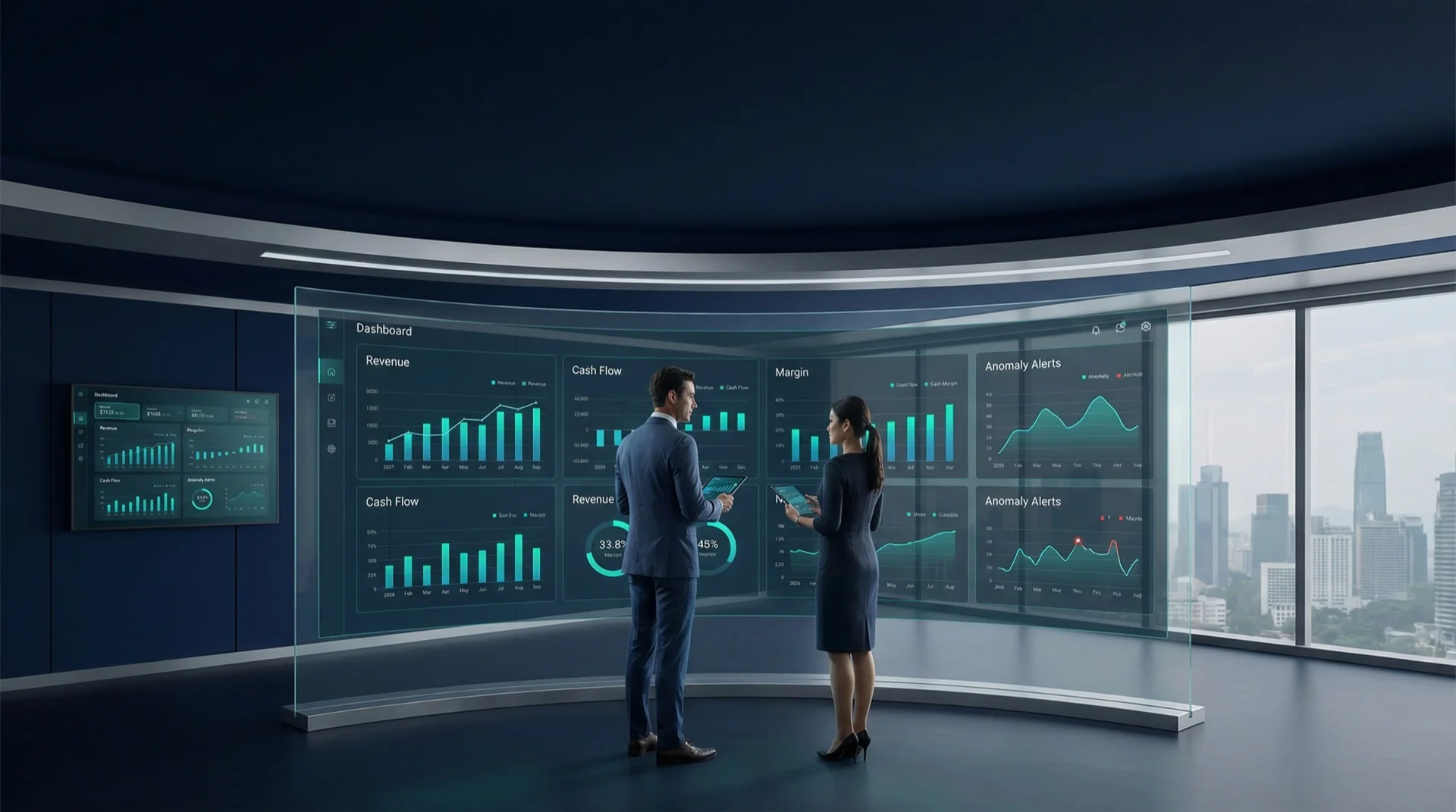
Financial Close Automation: How Malaysian Finance Teams Are Cutting Month-End Close from 15 Days to Same-Day
It is the 5th of the month. Your CEO wants last month’s numbers. Your board meeting is in ten days. And your finance team is still logging into five different systems, downloading CSVs, and reconciling data in spreadsheets that have become so complex that only one person in the department truly understands them.
Sound familiar?
The month-end close is the most time-consuming, error-prone, and universally dreaded process in corporate finance. In Malaysia, the average close cycle takes 10-15 business days. That means your leadership team is making decisions based on data that is already two to three weeks old by the time they see it.
But a growing number of Malaysian companies are compressing that timeline dramatically — some achieving same-day close — through financial close automation.
How? It starts with understanding where all that time actually goes.
Why the Traditional Month-End Close Takes So Long
Most finance teams assume the close takes 15 days because the work is complex. It is not. When you break it down, the majority of close time is spent on something far less glamorous: moving data from one place to another.
| Phase | Activities | Time Spent |
| Data Collection (Days 1-4) | Logging into ERP, banking portals, invoicing systems. Downloading exports. Chasing department heads for missing data. Waiting for subsidiaries to submit numbers. | 3-4 days |
| Data Reconciliation (Days 5-8) | Mapping columns across systems. Reconciling bank statements. Finding and investigating discrepancies. Hunting for that RM 500 difference. | 3-4 days |
| Analysis and Adjustments (Days 9-11) | Calculating variances. Preparing accruals and adjustments. Intercompany eliminations. Currency conversions. | 2-3 days |
| Report Preparation (Days 12-15) | Building management reports. Formatting board decks. Creating visualisations. Review cycles and corrections. | 3-4 days |
Look at that breakdown carefully. Roughly 60-70% of the close process is data collection and reconciliation — work that requires zero financial judgment. Your highly skilled, expensive finance professionals are spending most of their close cycle doing work that a machine can do faster and with fewer errors.
That is exactly the gap financial close automation is designed to fill. Here is how it works.
What Is Financial Close Automation (and What It Is Not)
Financial close automation uses technology to eliminate the manual steps that consume most of your close cycle. Rather than your team extracting data from systems, reconciling it in spreadsheets, and building reports from scratch each month, automated systems handle data ingestion, reconciliation, and reporting continuously.
That word — continuously — is the key. Traditional close processes treat financial reporting as a periodic event, something that begins after the month ends. Automated systems treat it as an ongoing process, so that when the month ends, the data is already consolidated, reconciled, and ready for review.
But let us be clear about what automation does and does not replace:
| Automated | Human Judgment Still Required |
| Data extraction from ERP, banks, invoicing | Interpreting unusual variances |
| Transaction matching and reconciliation | Determining appropriate accruals |
| Currency conversion at daily rates | Strategic commentary for the board |
| Intercompany elimination entries | Forecasting and forward-looking analysis |
| Standard variance calculations | Recommending corrective actions |
| Report generation and formatting | Stakeholder communication |
| Anomaly flagging | Final sign-off and approval |
Automation does not replace your finance team. It removes the manual data work so they can focus on the judgment calls, analysis, and strategic insight that actually matter.
Now let us get specific. Where exactly does a 15-day close lose the most time, and how does automation reclaim each of those lost days?
The Five Bottlenecks Killing Your Close (and How to Fix Each One)
Bottleneck 1: Data Scattered Across Multiple Systems
The problem: Financial data lives in your ERP, sales data in your CRM, banking data requires manual downloads from each bank portal, and operational costs are tracked in departmental spreadsheets. Your finance team starts each close by playing data detective.
The fix: A centralised data repository that connects to all source systems via API or automated feeds. Data flows in continuously — not once a month when someone remembers to download it. By the time the month ends, every transaction from every system is already in one place.
Time saved: 3-4 days eliminated entirely.
But getting the data into one place is only half the battle. The next bottleneck is what happens when it arrives.
Bottleneck 2: Manual Reconciliation
The problem: Your team spends days matching transactions between systems. Bank reconciliations alone can take a full day when you have multiple accounts across CIMB, Maybank, and RHB. Intercompany transactions between subsidiaries create additional reconciliation headaches.
The fix: Automated matching algorithms reconcile transactions as they arrive. The system matches 90-95% of transactions automatically, flagging only genuine exceptions for human review. Instead of reconciling 10,000 transactions, your team reviews 50 exceptions.
Time saved: 3-4 days reduced to 2-4 hours.
At this point, data is collected and reconciled — but your close still stalls if the numbers never arrive in the first place.
Bottleneck 3: Waiting for Data from Other Departments
The problem: Finance cannot close until every department submits their numbers. Operations is late with cost allocation. Sales has not finalised commission calculations. Marketing’s agency invoices have not been processed. Your close timeline is held hostage by the slowest department.
The fix: When source systems are connected directly, departmental data flows automatically. No email chains asking “Can you send me the December numbers?” because the numbers are already there. Where manual inputs are still needed, automated reminders and deadline tracking ensure nothing slips through.
Time saved: 1-2 days of waiting eliminated.
The data is in, it is reconciled, and departments are no longer a bottleneck. But there is still a silent killer lurking in your process — and it lives in a file called “Consolidated_FINAL_v2_Ahmad_edits.xlsx”.
Bottleneck 4: Spreadsheet Complexity and Version Control
The problem: Your consolidation workbook has 47 tabs, 12,000 formulas, and a macro that breaks every time someone updates the format. Three versions are floating around via email, and nobody is entirely sure which one is correct.
The fix: A single platform that handles consolidation logic natively. No spreadsheet formulas to break. No version control issues. One source of truth that everyone works from. Changes are tracked with a full audit trail showing who changed what and when.
Time saved: 1-2 days, plus elimination of formula-related errors.
Now the numbers are consolidated and clean. One step remains — and it is the one that drives finance teams the most insane.
Bottleneck 5: Report Building and Formatting
The problem: After the numbers are finalised, someone still needs to build the management report. Copy data into PowerPoint. Format the tables. Update the charts. Make sure the CEO’s dashboard matches the board pack. This is pure formatting work that adds zero analytical value.
The fix: Pre-configured report templates and dashboards that populate automatically when data is updated. The moment your numbers are finalised, the management report, board pack, and executive dashboard are ready. No copy-pasting. No formatting. No “the chart is showing January data instead of February.”
Time saved: 2-3 days reduced to minutes.
Add it up: across these five bottlenecks, automation eliminates 10-13 days from a typical 15-day close. The question is not whether it works — it is how to get there without disrupting your operations. Here is a practical roadmap.
The Path from 15 Days to Same-Day: A Realistic Roadmap
No company goes from a 15-day close to same-day overnight. Here is a realistic progression, based on what Malaysian companies have achieved through phased implementation:
Stage 1: Connect Your Data Sources (Weeks 1-3)
Link your core financial systems to the automation platform: primary ERP or accounting software, banking feeds, and key operational systems. The goal is simple — eliminate manual data downloads so information flows automatically.
Expected close improvement: 15 days → 8-10 days
Stage 2: Automate Reconciliation (Weeks 4-6)
With data flowing in automatically, the next step is configuring automated matching rules for bank reconciliations, intercompany transactions, and other recurring tasks. The system learns your patterns and handles the routine matching, leaving your team to review only the exceptions.
Expected close improvement: 8-10 days → 4-5 days
Stage 3: Standardise Reporting (Weeks 7-8)
Now that data collection and reconciliation are automated, the bottleneck shifts to reporting. Build your management report templates, board dashboards, and executive summaries within the platform so they generate automatically the moment numbers are finalised.
Expected close improvement: 4-5 days → 1-2 days
Stage 4: Continuous Close (Month 3+)
As the system matures, you move toward continuous close — where financial data is consolidated and reconciled in near-real-time throughout the month. The “month-end close” stops being a data processing marathon and becomes a review-and-approve step.
Expected close improvement: 1-2 days → Same-day
That is the mechanical path from 15 days to same-day. But faster close is just the headline. What companies gain after automating their close is often more valuable than the time savings themselves.
What Companies Actually Gain (Beyond Speed)
Better Decisions, Faster
When your CEO has last month’s actuals by the 2nd instead of the 15th, that is 13 extra days to act on insights. In volatile markets, that is the difference between catching a problem early and managing a crisis.
Reduced Audit Costs
Auditors charge by the hour. When your data is already consolidated with a complete audit trail, the audit process is faster and cheaper. Malaysian companies implementing financial close automation typically report 20-40% reductions in audit fees.
Finance Team Retention
Nobody pursued a finance degree to spend their career copy-pasting between spreadsheets. Automation frees your team to do the analytical, strategic work they were trained for. With finance professional turnover in Malaysia at 15-20% annually — and each replacement costing 3-6 months of productivity — this is not a soft benefit. It is a hard cost savings.
ESG and Compliance Readiness
For companies subject to Bursa Malaysia ESG requirements (NSRF/ISSB), financial close automation platforms that include sustainability metrics tracking mean your ESG data closes alongside your financial data. No separate process. No last-minute scramble for carbon numbers before the sustainability report deadline.
Convinced that automation makes sense? Good. But if you have tried technology solutions before and been burned, you probably have some objections. Let us address them head on.
Common Objections (and Honest Answers)
“Our systems are too old or fragmented for automation.”
Modern financial close platforms are designed to work with messy, fragmented environments — that is the entire point. If your data was already clean and unified, you would not need automation. Good platforms connect to legacy ERPs, local accounting systems, Excel files, and even manual CSV uploads as a bridge solution.
“We tried BI tools and they did not solve the problem.”
That is because BI tools (Power BI, Tableau, Looker) are visualisation layers. They show you pretty charts of whatever data you feed them. But they do not solve the upstream problem: getting data out of multiple systems, cleaning it, reconciling it, and consolidating it. Financial close automation handles the data pipeline, not just the presentation layer. It is the difference between a window and a factory.
“What about data security?”
A legitimate concern. Any platform you evaluate should have ISO 27001 certification, role-based access controls, read-only data access (the system should never modify your source data), complete audit logging, and data residency options for Malaysian compliance. If a vendor cannot check all these boxes, keep looking.
“Our team will resist the change.”
This is valid. But in our experience, the resistance disappears once you frame it correctly: we are not replacing you — we are removing the parts of your job you hate. When your senior analyst realises they will never have to manually reconcile a bank statement again, resistance tends to dissolve fast.
If these objections are resolved and you are ready to evaluate platforms, here is exactly what to look for.
How to Evaluate Financial Close Automation Platforms
Not all platforms are built equal. Use this checklist when evaluating options for your Malaysian business:
Data Integration
- Does it connect to your specific ERP/accounting system?
- Does it support direct banking feeds from Malaysian banks?
- Can it handle multi-entity and multi-currency consolidation?
- Does it accommodate manual data sources (CSV, Excel) as a bridge?
Automation Capability
- Does it offer automated transaction matching and reconciliation?
- Can it handle intercompany eliminations?
- Does it flag anomalies and exceptions proactively?
- Can non-technical users query data without SQL knowledge?
Reporting and Insights
- Does it generate management reports and board packs automatically?
- Does it include real-time dashboards for executives?
- Does it support ESG and sustainability reporting for Bursa compliance?
- Can users ask financial questions in plain language and get instant answers?
Security and Compliance
- Is the vendor ISO 27001 certified?
- Does it offer role-based access controls?
- Is there a complete audit trail for every data point?
- Does it support local data residency?
If you check these boxes and still hesitate, consider one final question.
The Cost of Not Automating
It is tempting to postpone automation and stick with what works. But “what works” is quietly costing you more than you think:
- Labour cost of manual close: A finance team of 4 spending 10-12 days on close = approximately 160-190 person-hours per month, or RM 150,000-200,000 annually in labour costs dedicated purely to data handling.
- Opportunity cost of delayed decisions: Every day your leadership waits for financial data is a day they are operating blind. In volatile markets, two weeks of delayed visibility can mean missed opportunities or undetected problems spiralling out of control.
- Error cost: Manual spreadsheet processes carry a 1-5% error rate. A single misreported figure can cascade into wrong decisions, compliance issues, or audit findings.
- Talent cost: Your best finance people are the most likely to leave if their work consists primarily of data entry and reconciliation. Replacing them costs 3-6 months of productivity.
The question is not whether you can afford to automate your financial close. The question is how many more 15-day cycles you can afford to run before the compounding cost becomes too large to ignore.
Start Your Journey to Same-Day Close
Lestar.ai by Mandrill Tech (ISO 27001 certified) is Malaysia’s leading AI-driven data repository that automates the entire financial close process — from data consolidation to natural language queries to ESG compliance tracking. Our CEO 360 platform gives your finance team the tools to close faster, with fewer errors, and more time for the strategic analysis your business actually needs.
Companies using Lestar.ai have reduced their close from 15 days to same-day delivery, cut data reconciliation errors by 80%, and freed their finance teams to focus on work that drives business value.
Book a CEO 360 Demo Today and see how your month-end close can go from a 15-day marathon to a same-day sprint.