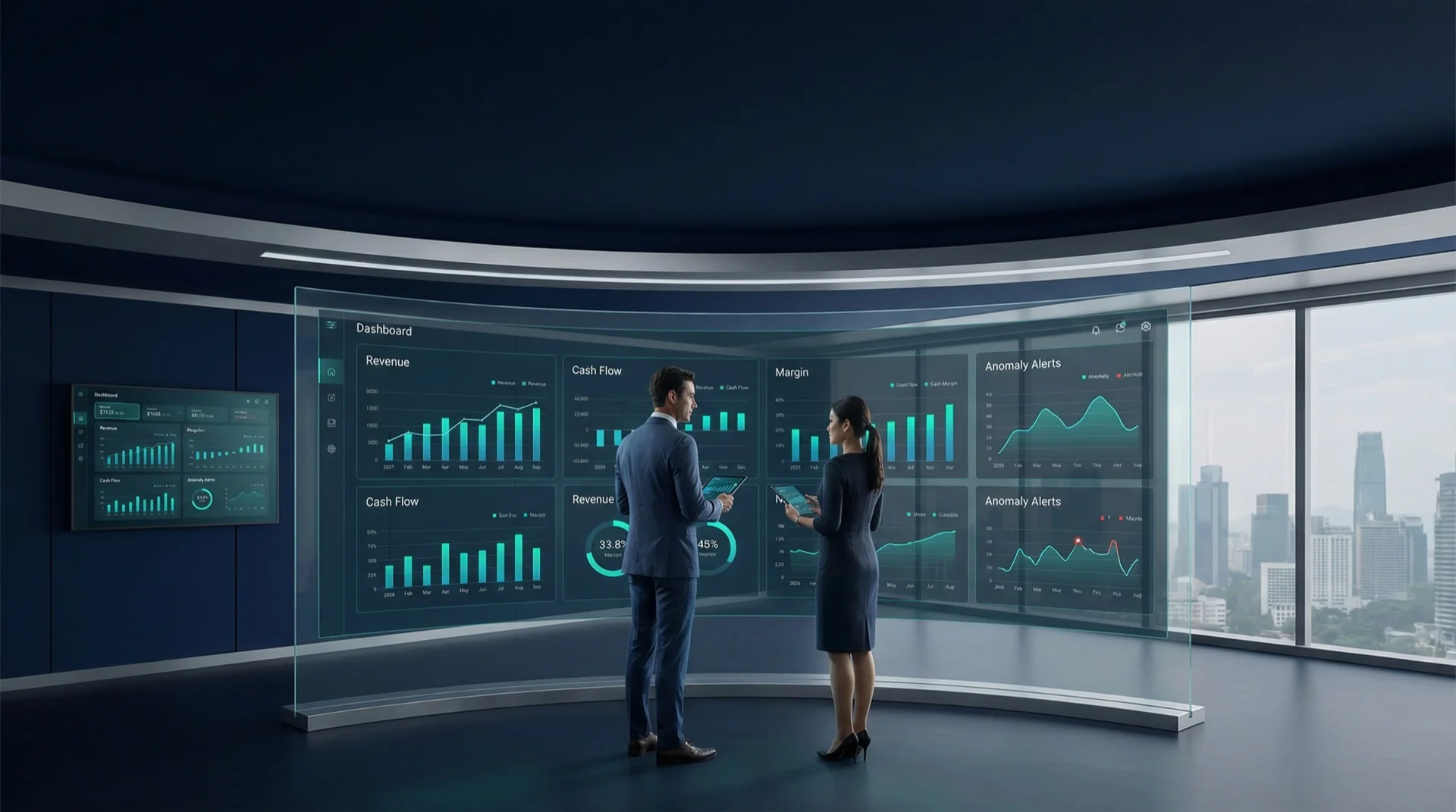
Best Cash Flow Forecasting Software for CFOs in 2026
Looking for the best cash flow forecasting software in 2026? This guide compares AI-driven platforms that give CFOs 30, 60, and 90-day forward visibility, replacing manual spreadsheets with real-time, connected financial dashboards. We cover key features, evaluation criteria, and how purpose-built FP&A tools outperform generic BI platforms for cash flow management.
Key Takeaways
- Cash flow forecasting software with AI-driven projections gives CFOs 30, 60, and 90-day forward visibility, replacing reactive spreadsheet-based planning.
- Purpose-built FP&A software connects directly to ERPs, accounting systems, and CRMs, eliminating manual data extraction and the reporting lag it creates.
- The right financial reporting dashboard integrates both financial KPIs and ESG metrics, addressing IFRS S2 disclosure requirements in a single interface.
- Anomaly detection via machine learning flags variance before it compounds, which is critical for multi-entity and multi-currency organisations.
- Lestar CEO 360 by Mandrill Tech Sdn Bhd (ISO 27001 certified) delivers near real-time financial dashboards, predictive cash flow forecasting, and conversational AI for CFOs at mid-to-large companies globally.
Table of Contents
- What Is Cash Flow Forecasting Software?
- Why CFOs Are Replacing Spreadsheets With Financial Reporting Software
- Key Features to Look For
- Purpose-Built FP&A Software vs. Generic BI Tools
- How to Evaluate Management Reporting Software
- How Lestar CEO 360 Delivers Real-Time Cash Flow Visibility
- A Practical Path to Implementation
- Frequently Asked Questions
- The Bottom Line
Introduction
Most CFOs can describe a version of the same problem: the board meeting is Monday, the cash position data is from last Friday, and the 13-week forecast was built on assumptions that are already three days stale. The data exists. It is sitting in an ERP, an accounting system, and a CRM. The problem is that nobody has connected it, cleaned it, and surfaced it in a format that supports a decision made today.
Cash flow forecasting software solves this problem at the infrastructure level. Rather than patching the spreadsheet process, it replaces it: live data feeds, AI-driven projections at 30, 60, and 90 days, and anomaly detection that surfaces variances before they become crises. This guide is written for CFOs, finance directors, and FP&A leaders evaluating cash flow forecasting tools in 2026. You will find a feature-by-feature comparison, a structured evaluation framework, and a detailed look at how Lestar CEO 360 by Mandrill Tech Sdn Bhd approaches this for mid-to-large companies operating across multiple currencies and regulatory regimes.
What Is Cash Flow Forecasting Software?
Cash flow forecasting software is a category of financial reporting software that automates the collection, modelling, and projection of cash inflows and outflows across an organisation. At the basic level, it replaces the manual process of pulling data from multiple systems and building a forecast in a spreadsheet. At the advanced level, it uses machine learning to detect patterns in historical cash movements, receivables aging, payment behaviour, and seasonal trends, and produces forward-looking projections that update automatically as new transactions occur.
The distinction between cash flow forecasting software and a generic financial reporting dashboard is significant. A dashboard reports on what happened. Forecasting software tells you what is likely to happen next, with enough precision and lead time to act on it. According to the Association for Financial Professionals (AFP), 82% of companies that experienced a cash crisis cited a failure in forecasting accuracy as a contributing factor. The tools available in 2026 are designed to close that gap through automation and predictive modelling, not through better spreadsheet hygiene.
For CFOs at companies operating across multiple currencies, such as MYR, USD, and SGD, the forecasting layer must also account for foreign exchange exposure, intercompany positions, and entity-level liquidity, all of which require data integration that spreadsheets cannot sustain at scale. For group CFOs managing multiple subsidiaries, this also means financial consolidation software capability built in: the ability to roll up entity-level cash positions, eliminate intercompany transactions, and present a consolidated group view automatically, without a monthly manual consolidation exercise.
Why CFOs Are Replacing Spreadsheets With Financial Reporting Software
The spreadsheet-based forecasting process has three structural weaknesses that compound as organisations grow: data latency, version control failure, and the inability to model at scale.
Data latency is the most immediately damaging. When a finance team manually exports data from an ERP, reconciles it against the accounting system, and formats it for review, the resulting numbers are already hours or days old. For cash forecasting, that lag matters: a payment delay, a credit facility draw, or a large receivable collected today changes the 30-day picture significantly. Financial reporting software with live ERP connectivity updates the forecast as transactions post.
Version control failure is the second structural problem. Gartner research has identified poor data quality and inconsistent definitions as the leading cause of forecast error in mid-market finance functions. When multiple team members work from different spreadsheet versions, minor discrepancies in formulas or data extraction dates compound into material forecast errors that only become visible at period-end.
Scale limitations are the third constraint. A CFO managing three business units, two currencies, and quarterly board reporting can maintain a spreadsheet-based process, but at a cost: it consumes significant analyst hours and introduces model risk every time a formula is updated. Purpose-built FP&A software eliminates this overhead by centralising the data model and automating the update cycle.
The shift away from spreadsheets is not a preference. A McKinsey Global Institute analysis found that finance functions spending less than 20% of their time on analytics (vs. data preparation) significantly underperform peers on forecast accuracy and decision cycle time. The arithmetic of that equation changes when the data preparation is automated.
Key Features to Look For
When evaluating cash flow forecasting software and associated financial reporting dashboards, CFOs should assess tools against a consistent capability framework. The table below maps each capability to its operational impact.
| Feature | What It Does | Why It Matters for CFOs |
|---|---|---|
| Live ERP and Accounting Integration | Connects directly to source systems; no manual data extraction | Eliminates reporting lag; ensures forecast reflects today’s transactions |
| AI-Driven Cash Flow Projections | Generates 30, 60, and 90-day cash forecasts using ML on historical patterns | Shifts planning from reactive to anticipatory; supports treasury decisions |
| Anomaly Detection | Flags unusual cost spikes, revenue drops, or budget variances automatically | Surfaces problems in days, not at month-end; critical for multi-entity orgs |
| Multi-Entity Financial Consolidation | Rolls up subsidiary data, eliminates intercompany positions, delivers group-level cash view | Replaces manual consolidation spreadsheets; essential for holding companies and multi-subsidiary groups |
| Financial + ESG Integration | Combines financial KPIs with sustainability metrics in one interface | Addresses IFRS S2 requirements; reduces dual-reporting overhead |
| Conversational AI Query Layer | Allows plain-language questions against live financial data | Reduces dependence on analyst intermediaries for ad-hoc queries |
| Role-Based Dashboard Views | Configures different views for CFO, CEO, and board | Ensures the right level of detail reaches the right decision-maker |
| Multi-Currency Support | Handles MYR, USD, SGD, and other currencies natively | Essential for organisations with cross-border operations or Bursa-listed entities |
| ISO 27001-Certified Security | Financial data managed under internationally audited security standards | Satisfies governance and audit requirements; reduces vendor risk |
Pro Tip: Before issuing an RFP for cash flow forecasting software, document the five to eight financial metrics your leadership team reviews every week. If a vendor cannot demonstrate how those specific metrics are automated, the platform is not ready for your organisation.
Purpose-Built FP&A Software vs. Generic BI Tools
CFOs frequently encounter a fork in the evaluation process: invest in a dedicated FP&A software platform, or extend an existing business intelligence tool such as Microsoft Power BI or Tableau to cover financial forecasting use cases. The distinction matters more than vendors on either side typically acknowledge.
Generic BI tools are powerful data visualisation platforms. They offer flexibility, broad connector libraries, and relatively low per-seat costs. However, they deliver those capabilities through a blank canvas: your team must build the financial data model, define the forecast logic, maintain the ERP connectors, and manage the update frequency. For a finance team that wants cash flow forecasting software up and running in four to eight weeks, a generic BI platform is not the starting point. It is a multi-month build project.
Purpose-built FP&A software arrives with the financial data model pre-configured. Forecast methodologies, cash flow categories, and reporting hierarchies are built in. ERP connectors are pre-tested against common systems. Anomaly detection is calibrated to financial KPI patterns, not generic data movements. The trade-off is reduced configurability, but for most CFOs, the faster time to reliable output is worth it.
The key evaluation question is this: does your organisation have the internal capacity to build and maintain a financial data model on a generic BI platform? If not, a purpose-built financial reporting software solution reduces both implementation time and long-term model risk.
How to Evaluate Management Reporting Software
A structured evaluation process reduces the risk of selecting a tool that looks impressive in a demo but fails in production. CFOs should work through four stages.
Step 1: Define your data sources. List every system that feeds your financial reporting today: ERP, accounting system, HRIS, CRM, treasury management, and any ESG data collection tools. The value of any management reporting software is directly proportional to how many of these it connects to without manual extraction. Request a connector map from each vendor and verify against your actual system versions.
Step 2: Validate forecast methodology. Ask each vendor how the cash flow forecasting engine works. Is it rules-based or ML-driven? What is the training data window? How does the model handle seasonality and one-time items? A vendor that cannot answer these questions clearly is not delivering real predictive forecasting; they are delivering a better-formatted spreadsheet.
Step 3: Run a parallel forecast. During the pilot, run the software’s cash forecast in parallel with your existing process for four to six weeks. Compare the 30-day projection against actuals at the end of each week. Track mean absolute percentage error (MAPE). This is the only reliable way to assess forecast quality before you are dependent on it.
Step 4: Assess security and compliance posture. For any platform centralising sensitive financial data, verify the vendor’s information security certifications. ISO 27001 certification indicates that the vendor’s security controls have been independently audited. For organisations reporting under Bursa Malaysia listing requirements or subject to PDPA obligations, this is not optional due diligence.
How Lestar CEO 360 Delivers Real-Time Cash Flow Visibility
Lestar CEO 360 is an AI-powered executive intelligence platform developed by Mandrill Tech Sdn Bhd, an ISO 27001 certified company. It is purpose-built for CFOs and finance leaders at mid-to-large organisations who need financial reporting software that connects, forecasts, and alerts, without requiring a BI development team to configure it.
Near real-time data integration. CEO 360 connects directly to ERPs, accounting systems, CRMs, and data warehouses. Dashboards update automatically as transactions occur. There is no manual extraction step, no CSV upload schedule, and no dependency on a finance analyst to refresh the numbers before a board meeting.
Predictive cash flow forecasting at 30, 60, and 90 days. The platform’s forecasting engine applies machine learning to historical transaction patterns, outstanding invoices, payment behaviours, and seasonal trends to generate forward-looking cash projections. These projections update continuously as new data flows in, giving CFOs a dynamic view rather than a static quarterly estimate. For organisations managing across MYR, USD, and SGD, the platform also functions as a financial consolidation software layer: entity-level positions, intercompany eliminations, and group-level cash consolidation are handled automatically, replacing the manual monthly rollup that group finance teams typically produce in spreadsheets.
Anomaly detection via machine learning. CEO 360 continuously monitors incoming financial data for deviations from expected patterns. When a cost centre exceeds budget by a material threshold, or when a receivables balance ages beyond normal parameters, the system surfaces the alert before it compounds. This is particularly valuable for multi-entity organisations where issues in one business unit can be masked by consolidated reporting.
Integrated financial and ESG reporting. CEO 360 is part of the broader Lestar ecosystem alongside Lestar ESG. Financial KPIs and ESG metrics appear in the same interface, which directly supports IFRS S2 requirements to disclose the financial effects of climate-related risks. CFOs no longer need to reconcile numbers across separate financial and sustainability platforms before board meetings.
Conversational AI for on-demand financial queries. The platform includes a conversational AI chatbot that allows executives to retrieve financial data by asking questions in plain language. A CFO can ask “what is our net cash position in our Singapore entity this week?” and receive an answer drawn directly from live data, without navigating report hierarchies or waiting for an analyst response.
Role-based views for CFO, CEO, and board. CEO 360 presents the same underlying data through different lenses depending on the viewer’s role. The CFO sees detailed financial drill-downs. The CEO sees strategic KPIs. The board sees governance and risk metrics. This eliminates the version proliferation problem that occurs when different stakeholders receive different report formats.
A Practical Path to Implementation
Implementing cash flow forecasting software does not require a year-long transformation programme. The most effective approach is incremental and validation-driven.
Start with five to eight metrics. Before selecting software, align your leadership team on the specific financial and operational metrics they need daily. Cash position, revenue run rate, gross margin, receivables aging, and headcount cost are typical starting points. If ESG metrics such as emissions intensity or Bursa sustainability disclosure data points are board priorities, include those in scope from the beginning.
Map your data sources before the demo. Prepare a list of every system that currently feeds your financial reporting. Bring it to every vendor conversation. The quality of a vendor’s connector library, and their ability to handle your specific ERP version, will be the primary determinant of implementation speed.
Run a focused pilot on one entity. Start with financial data from one business unit or one geography. Validate that the financial reporting dashboard delivers accurate, near real-time data before expanding. Track forecast accuracy against actuals for at least four weeks. This manages risk, builds internal confidence, and produces the evidence needed to justify a broader rollout.
Plan for change management, not just technical onboarding. The technology implementation is typically the easier half. Finance teams accustomed to controlling the data extraction process need a structured transition to a model where the dashboard is the authoritative source. Identify internal champions early, set clear expectations for the parallel-run period, and document the new workflow before go-live.
Frequently Asked Questions
What is cash flow forecasting software and how does it differ from a standard financial reporting dashboard?
Cash flow forecasting software is a specialised category of financial reporting software that automates the collection of cash inflow and outflow data from source systems and applies statistical or machine learning models to project future cash positions. A standard financial reporting dashboard shows historical and current performance. Forecasting software adds a predictive layer: 30, 60, and 90-day projections that update automatically as new transaction data arrives. The distinction is between a tool that tells you what happened and one that tells you what is likely to happen next.
What metrics should cash flow forecasting software track for CFOs?
At a minimum, cash flow forecasting software for CFOs should track net cash position by entity and currency, accounts receivable aging, accounts payable schedules, projected cash inflows from confirmed orders, and available credit facility headroom. In 2026, leading platforms also integrate ESG-related financial metrics, such as carbon cost exposure and sustainability capex, reflecting IFRS S2 requirements that link climate risk disclosure directly to financial reporting.
How long does it take to implement cash flow forecasting software?
For purpose-built financial reporting software with pre-built ERP connectors, a focused implementation covering one business unit typically takes four to eight weeks. Full enterprise rollouts across multiple entities and currencies take longer, generally three to five months depending on data complexity and the number of source systems. Generic BI tools configured from scratch for financial forecasting use cases can take six to twelve months before delivering reliable, executive-level output.
How is purpose-built FP&A software different from Power BI or Tableau for cash flow forecasting?
Power BI and Tableau are general-purpose BI platforms. They offer broad flexibility but require your team to build the financial data model, define forecast logic, and maintain ERP connectors. For cash flow forecasting specifically, that means significant internal development effort before the platform produces reliable output. Purpose-built FP&A software arrives with the financial data model, forecast methodology, and ERP connectors pre-configured. The trade-off is reduced configurability, but for most CFOs, the faster time to reliable forecast output and lower internal maintenance burden outweighs that constraint.
The Bottom Line
The gap between finance functions that forecast with real-time data and those that forecast with last month’s spreadsheets is becoming a structural competitive disadvantage. Cash flow forecasting software in 2026 is not a reporting upgrade. It is a decision infrastructure investment: the difference between knowing your 90-day cash position today and finding out in six weeks when the options have narrowed.
For CFOs at mid-to-large organisations, the evaluation criteria are clear: live ERP integration, AI-driven projections, anomaly detection, multi-currency support, and a security posture that meets audit requirements. Lestar CEO 360 by Mandrill Tech Sdn Bhd, ISO 27001 certified and purpose-built as an AI-powered executive intelligence platform, delivers each of these capabilities in a single interface, alongside ESG metric integration for organisations managing IFRS S2 obligations.
Request a demo of Lestar CEO 360 at lestar.ai to see how it handles your specific data sources, currencies, and reporting structure.
Sources: Association for Financial Professionals (AFP) Working Capital Survey; Gartner Finance Analytics Research; McKinsey Global Institute, “The analytics edge in investment banking and FP&A”; IFRS Foundation, IFRS S2 Climate-related Disclosures Standard.