ESG Reporting Standards Are Changing: Why Excel Can No Longer Handle Your Compliance Data
For years, sustainability reporting in Malaysia was largely a voluntary “nice-to-have” exercise often handled by a small team using a few spreadsheets. That era is officially over.
With the full adoption of the International Sustainability Standards Board (ISSB) standards—specifically IFRS S1 and IFRS S2, and the enforcement of Bursa Malaysia’s mandatory timeline, ESG reporting has shifted from a public relations activity to a rigorous financial compliance requirement.
The “alphabet soup” of reporting standards (GRI, TCFD, SASB, IFRS) creates a complex data environment that static spreadsheets simply cannot manage. For CFOs and Sustainability Officers, sticking to manual processes is no longer just inefficient; it is a significant compliance risk.
Here is why the shifting landscape of ESG reporting standards requires a move toward a Centralized Data Repository, and why Excel is failing modern enterprises.
The Core Standards: What Malaysian PLCs Must Know
To navigate the current mandates, it is critical to distinguish between the “Old Guard” and the “New Mandate.”
1. Global Reporting Initiative (GRI) The GRI standards remain the most widely used globally. They focus on “Impact Materiality”—how a company’s activities affect the economy, environment, and people. Most Malaysian PLCs are already familiar with GRI 305 for carbon emissions.
2. IFRS S1 & S2 (The New Reality) This is where the game changes. Unlike GRI, which looks outward at impact, the new IFRS standards focus on “Financial Materiality”—how climate risks affect the company’s cash flow and enterprise value.
- IFRS S1 (General Requirements): Requires disclosure of all sustainability-related risks that could affect the company’s finances.
- IFRS S2 (Climate-related Disclosures): Mandates specific metrics on climate resilience, including Scope 1, 2, and eventually Scope 3 emissions.
3. Bursa Malaysia’s Mandatory Timeline Bursa Malaysia has aligned its listing requirements with IFRS S1 and S2. As of December 2025, the grace period for the largest companies has effectively ended.
- Group 1 (Main Market, Market Cap ≥ RM2 billion):
- Status: Active Now.
- Mandatory compliance began for financial years starting 1 January 2025.
- The Implication: If you are in this group, your first mandatory reporting year is nearly complete. Your upcoming annual report must be fully compliant with IFRS S1 and S2.
- Group 2 (Other Main Market Issuers):
- Status: Starting Next Month.
- Mandatory compliance begins for financial years starting 1 January 2026.
- The Implication: You must have your data collection systems in place immediately. Waiting until late 2026 to organize your data will leave you non-compliant.
- Group 3 (ACE Market & Large Non-Listed):
- Status: Preparation Phase.
- Mandatory compliance begins for financial years starting 1 January 2027.
The Hidden Challenge: Mapping One Data Point to Many Standards
The biggest misconception about ESG reporting is that it is just “collecting data.” In reality, it is “mapping data.”
Consider a single electricity bill. In a manual Excel workflow, that one data point needs to be treated in three different ways:
- For GRI: It must be converted to kilowatt-hours (kWh) to show energy consumption.
- For IFRS S2: It must be multiplied by the correct Grid Emission Factor to calculate Scope 2 Carbon Emissions (tCO2e).
- For Financials: It must be tracked as an operating cost to analyze energy efficiency ROI.
When relying on spreadsheets, these calculations are often hard-coded into different files owned by different departments (Operations, Finance, HR). If the emission factor changes—which happens annually, you have to manually update every single sheet. Miss one, and your report to Bursa is factually incorrect.
Why a Centralized Data Repository is the Only Viable Solution
To meet the rigor of IFRS S1 and S2, companies must move away from siloed spreadsheets and toward a Centralized Data Repository, such as Lestar.ai. A centralized system treats data not as static numbers, but as dynamic assets.
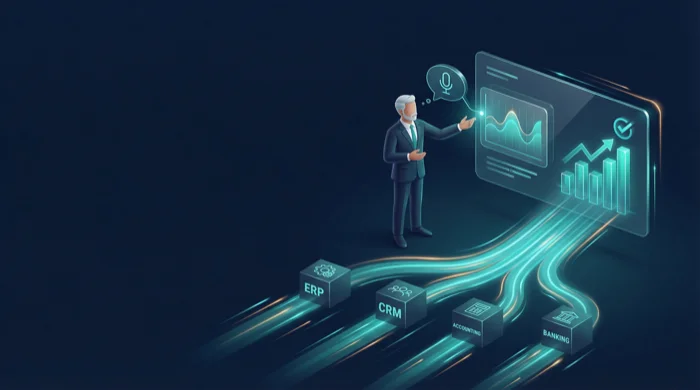
1. Single Source of Truth Instead of emailing spreadsheets back and forth, all departments upload raw data (invoices, meter readings, HR logs) into one platform. We act as the engine, automatically mapping that single data point to multiple reporting frameworks (GRI, IFRS, Bursa) simultaneously.
2. Audit-Ready Trails Auditors for IFRS standards require more than just a final number; they need to see the “receipts.” Excel cannot easily show who changed a formula or where a specific figure came from. A platform like Lestar.ai provides a digital footprint for every data point, allowing auditors to click through from the final report all the way back to the original source invoice.
3. Future-Proofing Logic ESG reporting standards are living documents. What is compliant today may change tomorrow. We update our backend logic as regulations evolve. This ensures that your calculations for carbon emissions or diversity ratios are always using the latest compliant methodologies, without your team needing to rewrite complex Excel formulas.
Case Study: The 2026 Audit Scramble
Imagine a manufacturing PLC facing their first mandatory audit under the new standards.
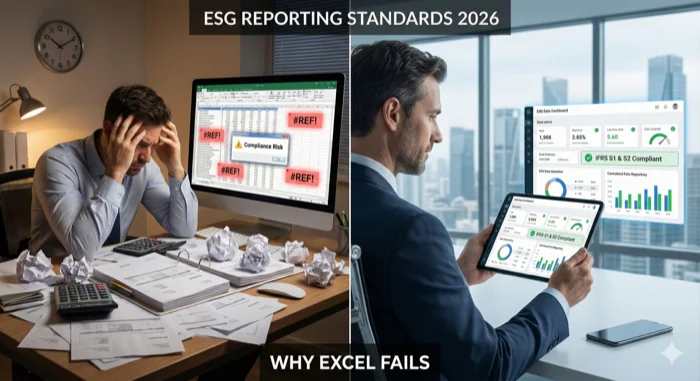
- The Old Way: The Sustainability Officer spends two months chasing factory managers for energy bills. The data comes in via WhatsApp, email, and paper receipts. The Finance team manually types this into Excel. A formula error in the “Scope 1” tab goes unnoticed until the external auditor flags it weeks later, delaying the annual report and raising red flags with investors.
- The Lestar Way: The factory managers have uploaded data directly into our system throughout the year. The platform’s AI Anomaly Detection instantly flagged a spike in energy usage months ago, allowing the team to correct the issue immediately. At the end of the year, the CFO generates the “Sustainability Statement” with one click, fully aligned with the latest IFRS S2 taxonomy.
Conclusion
The shift to mandatory ESG reporting is a signal that sustainability data now demands the same rigor as financial data. You wouldn’t manage your company’s multi-million Ringgit P&L on a loose collection of spreadsheets, so why manage your carbon liabilities that way?
As we move into 2026, the most strategic move a CFO can make is to automate the complex, manual work of compliance.
Related Reading
- Top ESG Reporting Software in Malaysia — Discover modern alternatives to manual ESG reporting processes.
- Best Sustainability Reporting Software 2026 — Comprehensive guide to modern ESG reporting solutions for CFOs.
- Best AI CFO Software in Malaysia: 2026 Buyer’s Guide — Full evaluation checklist for choosing the right platform.
Ready to secure your compliance for the year ahead?
Move beyond the risks of Excel.
[Book a Lestar Demo Today] to see how we help Malaysian PLCs build a single, audit-ready source of truth for their sustainability reporting.